

The world’s deadliest shipping waters in 2026? The Black Sea!
A Singapore-based customer recently told us how difficult it has become to fix tanker tonnage for Black Sea cargoes. According to The Wall Street Journal (Nov. 12), more than 300 attacks have been recorded in the Black Sea this year, putting commercial shipping under unprecedented pressure.
That got us thinking at Precise: Can we actually measure how small-tanker traffic is changing across the Black Sea?
So we turned to AIS data to explore how the situation is affecting tanker movements across the Black Sea.
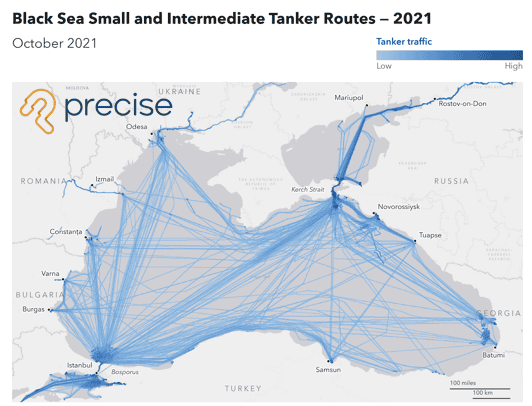
Comparing October 2021 with October 2026, AIS tracks from small and intermediate tankers reveal a striking transformation in navigation patterns. Coastal corridors off Türkiye, Romania, and Bulgaria appear to have gained prominence, while AIS-observed traffic around Odesa, Novorossiysk, and the Crimean Bridge has declined sharply. Our comparative map tells the story: red highlights tanker movements observed in October 2026, while blue marks 2021 routes that have largely disappeared from the AIS data.

But what about the cargo market?
Looking at reported Black Sea spot cargoes in 2026, we found that just 6% of Black Sea stems originated from Russian ports, predominantly comprising edible vegetable oils, with a smaller share of refined petroleum products. Are trade flows fundamentally disappearing, or are more fixtures being concluded outside the visible spot market?
AIS gaps don’t mean vessels are absent, just as fewer reported cargo stems don’t mean trade has disappeared. But one thing is clear: small-tanker trading in the Black Sea is increasingly complex. As routes shift, tonnage tightens, and market visibility fades, up-to-date data becomes a competitive advantage.
You can’t control Black Sea market uncertainty. But you can make sure your chartering strategy isn’t navigating blind.